
Minimum & maximum creative time
As a budding artist, there is one piece of advice you will hear time and time again: “Make art every day.” The purpose of this is simple: by making art every day, we are committing to our practice.
The directive to make art daily often implies producing finished pieces (see popular projects such as Inktober, The 100 Day Project, or the appropriately named Make Art Everyday). This rapid, iterative approach is a worthy effort, but sometimes I don’t find it meaningful to make a piece of art every day. I want to work incrementally towards larger projects and stretch myself beyond my sketchbook. However, sketching a few thumbnails or journaling ideas can feel like I’m not “making art” every day because I don’t have a finished product to show.
Perhaps you too like to work across mediums. You have lots of divergent ideas for creative projects. Sometimes you can’t get to your materials to make anything tangible. You have unpredictable days which makes it hard to identify what a reasonable output looks like. What could be an alternative approach for committing to your practice while allowing for more flexibility and balance?
Instead of making art daily, I like to identify my minimum and maximum creative time. I make lists of the smallest or largest actions I can do in a day to feel like I’ve meaningfully contributed to my creative work, then I’ll estimate the time it takes to do each action and order them by time period.
By finding the min and max amount of time I can devote to my creative work and identifying specific actions I can take, I can feel accomplished while taking care to avoid burnout. I feel good knowing there is room in my daily practice for experimentation and creative freedom.
When I am very low energy, I know I can just spend five minutes towards my work and call that day successful. When I have lots of time and space, I still like to cap my maximum at four hours per project area. I find that I can’t really go beyond this limit without feeling like a shell of myself.
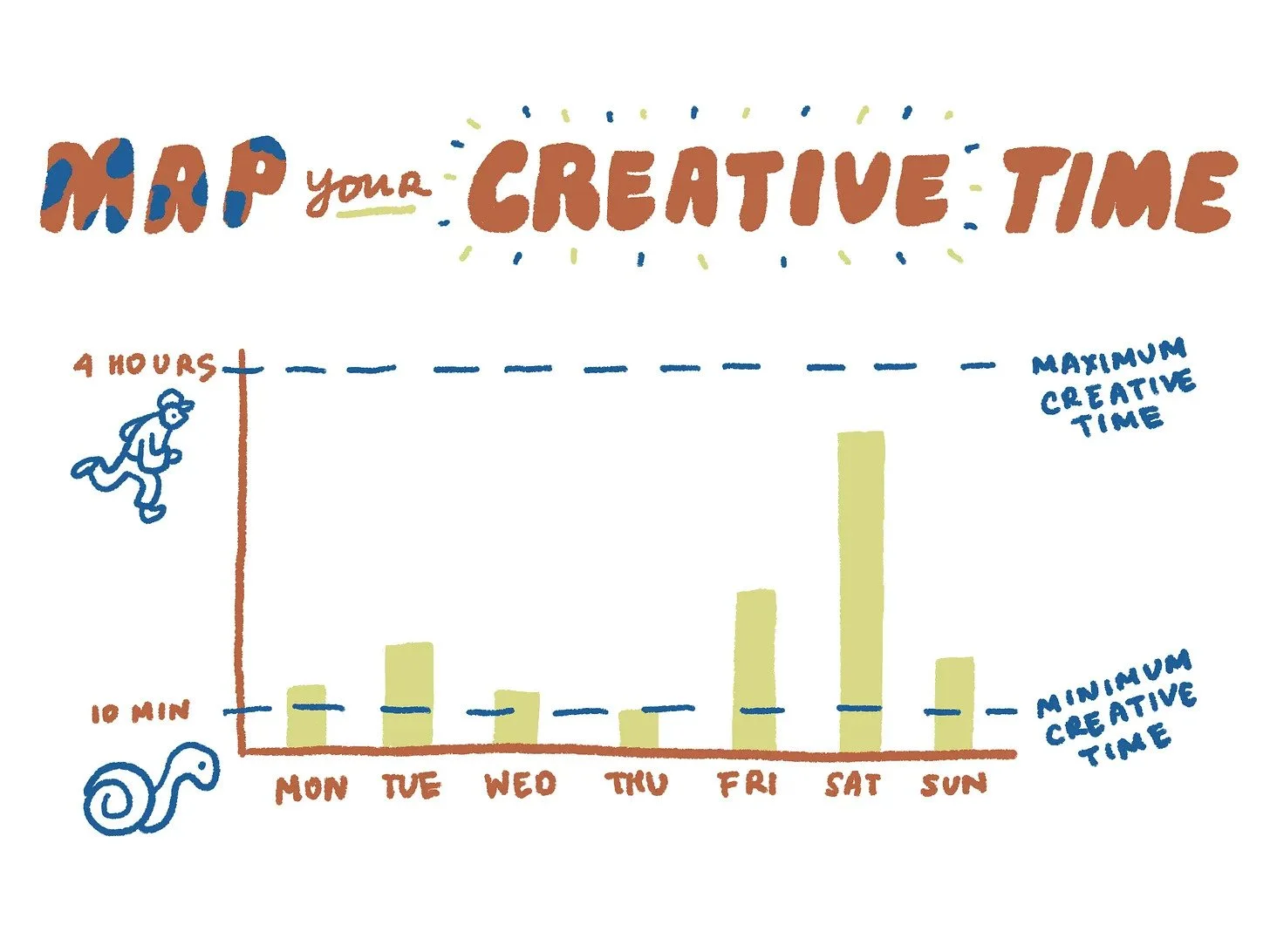
Finding your min & max creative time ⏳
A sample weekly chart of my creative time
To find your own min and max creative time, start with reflection. What’s most important to you in your practice, and what would you like to work on? Or as Austin Kleon writes, “what is the bare minimum amount of creative work you can do in any one day and still feel like a whole person?”
Make a list of actions you can do in a day to progress on your work, both tiny and large. Estimate the time it would take to complete each action and group them into time period buckets. Once you have your list, you can refer to it to make daily progress on your work depending on how much time and energy you have.
Here are some examples of what your time periods could look like:
5 minutes:
Recording your ideas in a voice note for an ongoing project
Taking a reference photo of yourself for a future painting
Drawing a quick journal sketch of your day to turn into a comic
Editing a photo for an upcoming newsletter post
10 minutes:
Drawing three thumbnail ideas for a painting
Rewriting a paragraph that you’ve made edits on
Making a list of observations of a plant for a poem
Testing red colored pencils to find the perfect shade to use in your next piece
Choreographing one 8-count of a dance routine
4 hours:
Refining a thumbnail into a detailed sketch
Painting the first and second layers of your artwork
Creating a set of spot illustrations for your web project
Taking a short video from scattered clips to a fine cut
Writing a chapter of a novel
Outlining a 24 page zine
Editing a series of photographs for a visual essay